Wednesday, April 17, 2013

Writing Fantasy in Second Grade

In April, many second grade classrooms will be trying out a new genre with the unit of study on Fairy Tales/Folk Tales/Fantasy. These students have a great foundation for this genre since they know how to write personal narratives and realistic fiction. Now the trick is to get them to explore this type of fiction. The main thing the teacher needs to keep in mind is that these seven-year-olds are going to just be approximating this type of writing.  It won't look like The Lion, The Witch and The Wardrobe or even Harry Potter.  Remember to take each student where they are and help to make them a better writer. Take baby steps.

The purpose of teaching this genre is to go along with the Common Core State Standards. They are asked to read this genre, so why not write it, too. The thinking is that some day in the future, when these second graders will be taking the high stakes tests, they will be asked to write this genre. We want to give them enough background to help them feel comfortable doing that.

Here is a unit of study that I put together with things from Lucy Calkin's Curriculum Plan for the Writing Workshop.  Hopefully, it will help you in this new adventure of fantasy writing!

Second Grade Writing Unit   Fairy Tales/Folk Tales/Fantasy
Adapted from A Curricular Plan for the Writing Workshop, Grade 2, 2011-1012 by Lucy Calkins and the Colleagues from the Reading and Writing Project

­­­­­Things to Remember
  • This unit is designed to expose students to the power of this genre in teaching story arcs and specific life lessons
  • This unit is designed to give students more practice in writing fiction
  •    It is important to immerse students in this genre through read alouds and discussions about the structure
  • Anchor charts created in other units of study are made available for student use
  • Students will practice comparing and contrasting two or more versions of the same tale
  • Launching the unit:
    • Through literature
      •   The Wolf Who Cried Boy by Bob Hartman
      •   The Little Red Hen (Makes a Pizza) retold by Philemon Sturges
    • Through Text book (Macmillan Treasures
      •   Farfallina & Marcel; Hermie the Hermit Crab; Pip the Penguin
      • Head, Body, Legs; Telling Tales; The Story of the Giant Carrot; Three Wishes from a Fish; Three Dog Wishes; Click, Clack, Moo Cows That Type
      •  Pushing Up the Sky; Why Sun and Moon Live in the Sky; Why the Sky is Far Away; Sky Seeds
      • Mice and Beans
  • Make sure you keep these few things in mind as you get started:
    • Give students a choice about what they want to write
    • Give students a chance to be immersed in this genre before starting to write
    • Still walk through the writing process (plan, draft, revise, edit, publish)
Menu of Teaching Points:  Fairy Tales/Folk Tales/Fantasy

Goal #1: Writers plan before they begin to write
  •   Writers think about what they could change in their adaptation of the story
  • Writers make many adaptations of the story
  • Writers plan their stories in a booklet or storyboard
Goal #2: Writers make important decisions while they write
  • Writers ask themselves many questions as they plan their stories
  • Writers work with writing partners to work out their choices and change their versions
Goal #3: Writers choose one plan and begin to write
  • Writers take a number of pages and transfer their ideas by using sketches
  • Writers are storytellers using dialog, action and thinking
  • Writers act out the scene or tell it over and over to get a clear idea of what to put on the page
Goal #4: Writers reread what they have done and plan what to do next
  • Writers reread to see how to make their stories stronger
  • Writers make stronger beginnings by using: “Once upon a time”
  • Writers use language for transitioning: “but, then one day…” or “Not long after that…”
  • Writers use sentence length to strengthen their stories
Goal #5: Fairy Tale writers use similar story structure
  • Fairy Tale writers use a main character and create a wish or problem for the character
  • Fairy Tale writers build the problem throughout the story with a solution at the end
  • Fairy Tale writers use tension to hook their reader
  • Fairy Tale writers use dialog, action and show-not-tell to keep the reader’s attention
  • Fairy Tale writers make each scene like a ‘small moment’ story
  • Fairy Tale writers use endings with “happily ever after.”
Goal #6: Fairy Tale writers teach readers a lesson
  • Fairy Tale writers think about what they want their readers to learn
  • Fairy Tale writers work with partners giving each other advice
Goal #7: Fairy Tale writers may adapt a story by writing a whole new version of the fairy tale told
                from a different character’s point of view

Goal #8: Fantasy writers use what they know about realistic fiction to help write in this genre
  • Fantasy writers feature a character with a problem just like realistic fiction writers
  • Fantasy writers use magic or an imaginary setting instead of something real as in realistic fiction
Goal #9: Fantasy writers act out parts and storytell over and over again
  • Fantasy writers work with a partner to storytell or act out their piece
  • Fantasy writers use dialog and very small actions into the their writing
Goal #10: Fantasy writers stretch out their fantasy stories
  • Fantasy writers use story arcs to help develop the problem in the story
  • Fantasy writers create obstacles that keep the reader on the ‘edge of their seats’
  • Fantasy writers think outside the box about how to use magic to help their character
  • Fantasy writers use charts around the room (old and new ones) to make good choices in their writing
Ways to Structure Fairy Tale/Folk Tale/Fantasy Writing
  • Write a fairy tale from another point of view: different characters, different setting, different problem
  • Write a whole new piece making up the characters and problem for a fairy tale or folk tale
  • Write a whole new piece using new ideas for magic and make believe for a fantasy story


Monday, April 15, 2013

It's Monday! What Are You Reading? How About Some Anthony Browne?

Today I want to share a couple of my favorite books.  They are both by the author, Anthony Browne. He is also the illustrator. As many classrooms are getting ready for the high stakes testing in multiple choice, they are focusing on inferencing. These books are wonderful for that comprehension strategy.  Looking at the art work and the story that the pictures are telling us, is a way to exercise our inferring muscles. Anthony Browne has a special way of getting the reader to look deeper at the story. What is really happening? What is really happening?
The book Voices in the Park is one that can help students to look at things deeper. I will be posting at a later time the lesson plan for using this book with students. For right now I will just focus on the actual story. Reading it as a Read Aloud is a perfect way to get students familiar with the Anthony Browne "style". Putting the book on the document camera so students can actually see the pictures as you read, is a better way to allow students to discuss at a higher level.

Another of Anthony Browne's books is The Shape Game.  In 2001-2002, Browne was a writer/illustrator in residence at Tate Britain in London. He taught literacy using the resources in the gallery. This book is based on the responses to works of ark in the collections. This is a great Art/Literacy connection book. Again, I love the way Anthony Browne uses the illlustrations to tell the story as much as the words.
A study in Browne books would be beneficial during this time of test prep. However, a study of his books is also beneficial for writing workshops any time of the year! Hopefully, you and your students will discover the wonder of Anthony Browne's world!

Friday, April 12, 2013

Cross Genre Writing in First Grade

As much as we as teachers, do not like it, there are times when students are tested on their skills as writers. One way to prepare them for this is to revisit the genres that they have been writing all year. This also is a chance for those students who always seem to write about the same topic no matter what the genre is. They just have a passion for that topic.

In first grade the students have written in these genres: Personal narratives, Realistic Fiction, Opinion/Persuasive, and Informational (How-To, All About). These are the genres that would be focused on in this Cross Genre study. Students would take a topic they are passionate about and write in each of those genres.

It might look like this with the topic of DOGS:

Genre                                         Example

1. Personal Narr.                      A story about you and a dog
2. Realistic Fiction                    Story about made-up character and dog
3. Informational                        All About Dogs
4. Opinion/Persuasive              Why dogs make the best pets

The first step would be to have mentor texts available using one topic in these genres. Here is an example with the topic being Fireflies:

Personal Narr. Fireflies by Julie Brinckloe
Realistic Fiction: The Very Lonely Firefly by Eric Carle
Informational:  Living Lights;  Fireflies in Your Backyard by Nancy Loewen
Opinion/Persuasive:  A letter written by the teacher about saving fireflies


 Writing one genre a day is a great way to start this unit of study.  After those four days, then they may go back and work on finishing the pieces or revising and editing them.  A folder of writing with the focus on one topic could be the end of the unit goal.


Wednesday, April 10, 2013

Authors as Mentors for Kindergarten

Bulletin Board display from Kindergarteners in New York City
This month many kindergarteners will be using Authors as Mentors as their unit of study. This is a time when students will use various authors as their writing teachers. They will develop styles, strategies and craft like a certain mentor writer. To do this the class will study several authors. They will read books written by the mentor authors and find what makes those writers unique.

First, a mentor author needs to be chosen to start the month. Some of the authors I have used are: Donald Crews, Ezra Jack Keats, Kevin Henkes and Tomie de Paola. As you choose your authors, they should be ones who can help students with craft. What the teacher already knows about her class of writers will help her make that choice.

After one author is chosen, the teacher will do a read aloud reading the book twice--once for enjoyment and once to look for various craft moves. Using a chart with the author's name and perhaps picture on top will be where craft moves of the book are listed. As this author is being studied, different books by him/her will be read each day. The chart will have more craft items listed on it. Students will try to model what they have learned from that day's author in their own writing.

Children will be looking at the world through writer's eyes. They will see things in a different way---a way to turn what they see into a story. In order to capture these details of their lives, they may want to carry Tiny Topic notebooks with them. They can then jot down words or sketches of things that happen in their lives. This will give them a collection of ideas to use as stories.


Lesson: Authors As Mentors: Ezra Jack Keats (The Snowy Day)
Materials: many E.J. Keats books; chart paper
Prepare/Purpose:
You have heard lots of books this year. Your teacher has read them to you and you have even read some books. Who is the person who writes the words in a book? That’s right, the author. Who is the person who draws the pictures in a book? That’s right, the illustrator. Sometimes the author and illustrator are the same person, they do both. Today and for several days, we are going to look at one author. We are going to look at the book he wrote and see what he did that we could do as writers. Are you ready?
New Learning:
We are going to start by looking at the author Ezra Jack Keats. You have already heard many of his books. He wrote the book: The Snowy Day. I bet you have heard that book.
Let’s make a chart that says: Ezra Jack Keats, and look I have his picture right here. We will put it up here beside his name. Remember I said we are going to look at the book The Snowy Day? Well, I have the picture of the cover and I am going to put it right here.
We are going to listen to the book again. But this time I want you to be listening for things that you could do like Mr. Keats is doing. Ready? Read the book to them.
What did you notice? Pick out things like: put spaces between his words. He drew the pictures, too. Sometimes wrote only a few words on a page. His words matched his pictures.
Active Engagement:
Turn and talk to your partner about what E.J. Keats did in his book that you could do in your book today. Have a few of them share.
Practice:
When you go back to your seat today, think about how you could write like Mr. Keats. He will be your writing teacher. Those of you who do something like Ezra Jack Keats will get to share. Happy writing!

Friday, March 29, 2013

Happy Easter From Gramma Preschool

This week at Gramma Preschool we did some fun spring things.  We first of all had reading and read some spring books. Then we worked with words using magnetic letters.
We also made playdough using spring neon colors. When we were done, we had three different colors all put in individual zip lock bags to take home.
For writing this week we did Easter cards. She made one for Mom and one for Dad. She wrote their names on the front and added stamps using ink pads. On the inside she wrote Happy Easter and signed her name!
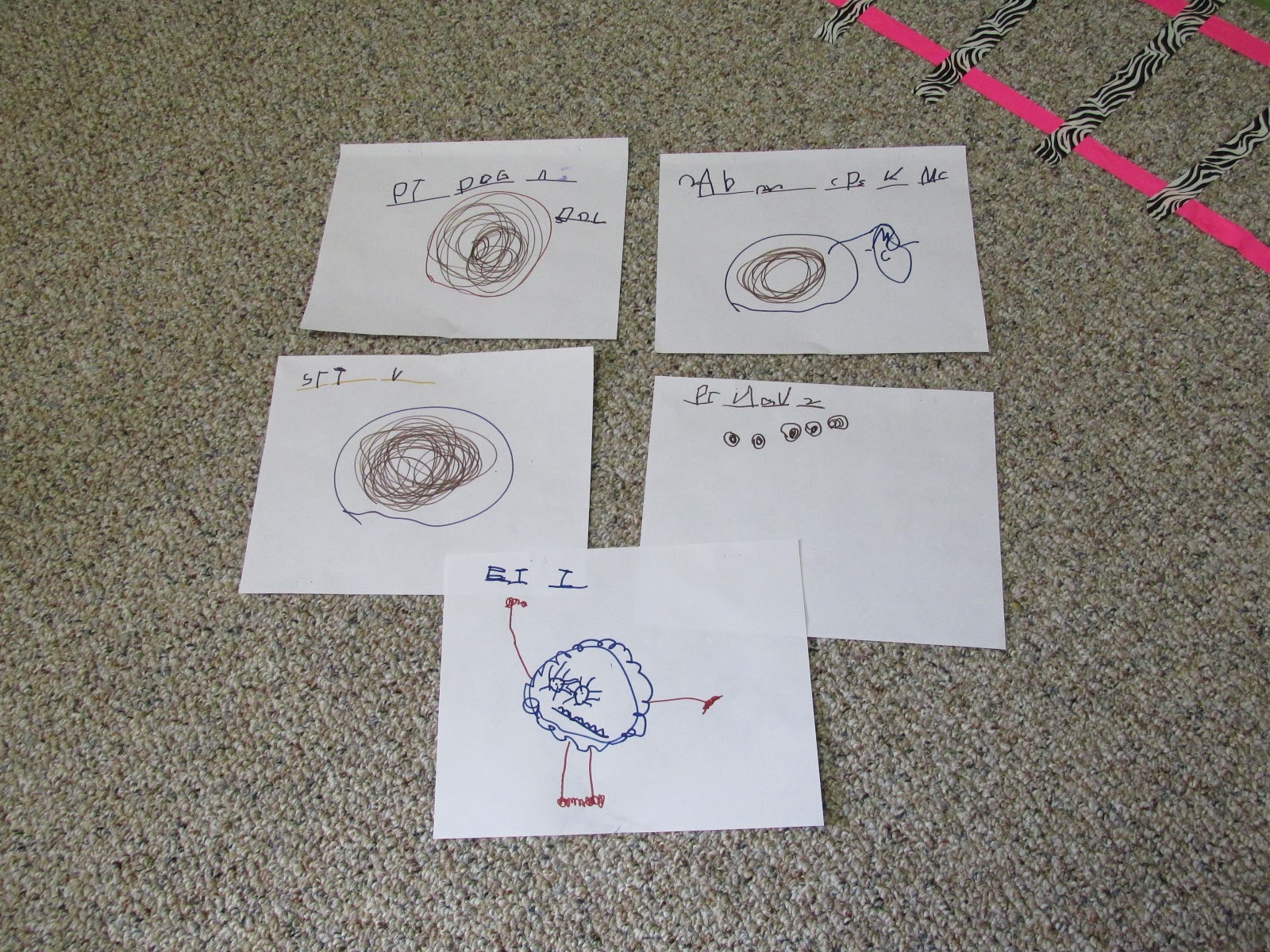
The last time she was here, she made chocolate instant pudding for her snack. Afterward, she wrote a How to book on How to Make Chocolate Pudding.  She was quite the expert on that!
1. Put in pudding 2. Add 2 cups of milk 3. Stir it up 4. Put in cups 5. Eat it!

Wednesday, March 27, 2013

Poetry: Ordinary to Poetic

As you are writing poetry in your classrooms, it might be fun to try something new. The lesson I will share with you today is all about how you look at things. Just observing the every day normal things around us can turn us into wonderful poets.  Try this and see what you think!


Lesson: Poetry—Ordinary to Poetic
Material: paper to write on or notebook

T.Point: Poets write with poetic language not ordinary language.
CONNECTION:
You have been working on poetry and have a sense of what poems sound like.  One of the things poetry does is that it helps us look at the world in a new way and describe it like no one has before.  Today, we’re going to write a poem together that tries to do just that. 
TEACHING:
Let’s look at something together---how about the trees outside the window here?  [On a chart draw a line down the middle. On top left write Ordinary and on the right Poetry.] 

            Look at the trees and tell me the first words that come into your minds.  Poets often begin their poems this way with “anybody’s words”.  [Write down words such as: green, tall, leaves, old.] 

            Now we’ll read those words together.  Do they sound like a poem?  NO!  This is what poets do.  They write a few words down, and then they reread it and sometimes realize that they have to go back and resee.

            Now, let’s look at the tree again, even more closely.  What kind of green is it?  The green of the ocean?  How old is it?  [Write down what they say: trees are as green as limes; majestic giants; their leaves are jewels; historic recorders of time.]

            Now, we’ll read these words.  Do they sound more like poetry?  Yes, because we looked at them with poetic eyes.
ACTIVE ENGAGEMENT:
            Now I want you to choose an interesting object to look at—either out the window or in the classroom.  When you have your object turn and tell your elbow buddy.

LINK:
Now at your seat start a new paper.  Under ordinary describe the object using the first words that come into your mind.  Then under poetic transform these descriptions into poetry by using metaphor and simile or describing its exact details.

Friday, March 22, 2013

Using Charts to Enhance Your Teaching

It is amazing to see how teachers use charts in the classroom to keep thinking in front of the students at all times. Charts that are made WITH students or BY students are the most valuable.  Even though the posters that can be bought are beautiful and colorful, they are not as powerful as those you make yourself with the children. 
This chart is about the features of nonfiction writing. Notice how bright and colorful it is. Notice how you can really tell that it was made by the teacher, not bought. It is also amazing how the charts were all around the classrooms of those we visited in New York. They found space to display the charts where students were able to see it easily.
 
This is a chart that the teacher and students have done together about Talk Styles. After this has been discussed and used, it is then put onto chart paper and displayed in the room. It is something that the students will use each and every day.
 

Charts in the classroom are not just for language arts. This chart is one that would be used in math. It is on Problem Solving.  What a great way to have this thinking in the room where the teacher can refer to it over and over.


This chart was posted in the hall as we walked by it. However, I am sure it was in the classroom during this unit of study. It was from a kindergarten class and a rubric of their writing.
 
 
As I said before, charts are everywhere. I think almost every classroom had charts hanging from a wire that went from one side of the room to the other. They were high, but still available to the students. Recording their thinking is so important for their learning!